- Published on
7 AI Automation Tools for Streamlined Workflows in 2026
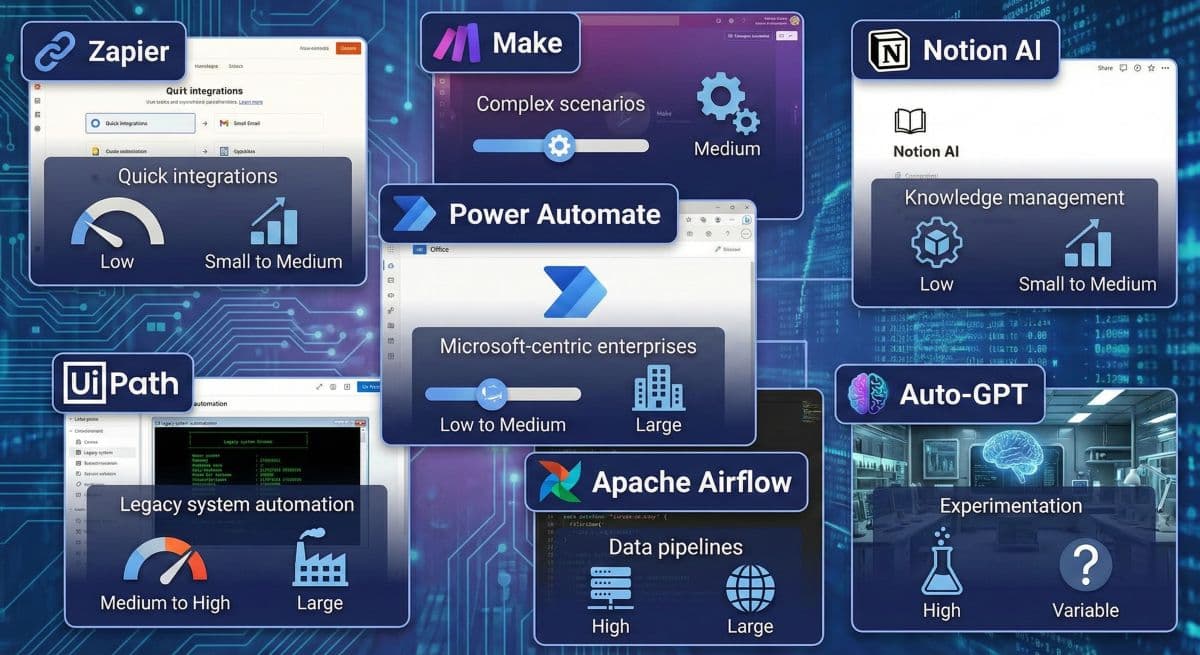
Table of Contents
- Introduction
- 1. Connecting Workflows With Zapier
- 2. Designing Complex Scenarios With Make
- 3. Leveraging Ecosystems With Microsoft Power Automate
- 4. Implementing Robotic Process Automation With UiPath
- 5. Automating Knowledge With Notion AI
- 6. Orchestrating Pipelines With Apache Airflow
- 7. Testing Agent Frameworks With Auto-GPT
- Choosing the Right Tool
- Conclusion
Introduction
Every team has that spreadsheet. The one someone manually updates every morning. Or the Slack message that triggers a chain of copy-paste operations across three different systems. These small friction points add up. A few minutes here, an hour there, and suddenly a significant chunk of the week disappears into coordination work that adds no real value.
Automation tools have matured beyond simple triggers and actions. The current generation handles conditional logic, adapts to context, and integrates AI capabilities without requiring a dedicated engineering team to maintain them. The tradeoff is choosing the right tool for your specific situation—what works for a three-person startup looks nothing like what an enterprise data team needs.
Here are seven tools worth evaluating, organized by complexity and use case.
1. Connecting Workflows With Zapier
Zapier remains one of the most widely adopted automation platforms because it sits comfortably between simplicity and power. It connects thousands of apps and allows non-technical teams to automate repetitive workflows without touching code. What makes Zapier valuable is not just the number of integrations, but how quickly workflows can be tested, adjusted, and scaled without breaking existing processes.
Modern Zapier workflows increasingly rely on conditional logic and lightweight AI steps rather than linear triggers. This allows teams to:
- Route tasks differently based on context
- Enrich records automatically
- Summarize inputs before passing them downstream
The result is less manual sorting and fewer handoffs between tools that were never designed to talk to each other.
Best Practice: Treat Zapier as connective tissue rather than a central brain. Teams that use it as an orchestration layer, not a dumping ground for logic, tend to see the biggest gains in speed and reliability.
2. Designing Complex Scenarios With Make
Make (formerly Integromat) appeals to teams that want deeper control over how automations behave. Its visual scenario builder exposes data structures and execution paths in a way that feels closer to engineering, without requiring full developer involvement. This makes it especially attractive for operations and analytics teams managing complex, multi-step workflows.
Where Make stands out is error handling and transparency. Each step shows exactly what data is being passed, transformed, or dropped. When something fails, diagnosing the issue feels deliberate rather than mysterious. That visibility reduces the fear that automation will quietly break something important.
Key Strengths:
- Visual debugging of data flow
- Granular error handling
- Support for branching logic and API calls
- Non-standard integration capabilities
Make rewards teams willing to think in systems rather than shortcuts. It is less forgiving than simpler tools, but far more powerful when workflows involve complex transformations.
3. Leveraging Ecosystems With Microsoft Power Automate
Microsoft Power Automate fits naturally into organizations already embedded in the Microsoft ecosystem. It integrates tightly with Excel, SharePoint, Outlook, Teams, and Power BI, allowing automation to happen where work already lives. For enterprises, this reduces friction around security, permissions, and compliance.
Recent improvements have pushed Power Automate beyond simple task automation. AI Builder components enable:
- Document processing
- Form extraction
- Basic prediction without requiring separate machine learning pipelines
These features are particularly effective for automating administrative and finance workflows that rely heavily on structured documents.
Best For: Environments where standardization matters. While it may feel rigid compared to more open-ended tools, that rigidity often translates into stability at scale.
4. Implementing Robotic Process Automation With UiPath
UiPath represents a different approach to automation, focusing on robotic process automation (RPA) rather than app-to-app workflows. It excels in situations where legacy systems, desktop software, or poorly designed interfaces make API-based automation impractical. Instead of integrating systems, UiPath mimics human interaction with them.
This approach allows organizations to automate workflows that would otherwise remain manual for years:
- Data entry across legacy systems
- Report generation from desktop applications
- System reconciliation tasks
- Form filling and submission
When paired with AI components such as document understanding or computer vision, these automations become far more adaptable.
Important Consideration: UiPath requires thoughtful governance. Without clear ownership and monitoring, bot sprawl can become just as problematic as manual chaos. Used intentionally, it unlocks automation in places most tools cannot reach.
5. Automating Knowledge With Notion AI
Notion AI brings automation into the knowledge layer rather than operational plumbing. Instead of moving data between systems, it accelerates how information is created, summarized, and reused. This is particularly valuable for teams drowning in internal documentation, meeting notes, and project updates.
Automation in Notion often looks subtle:
- Pages update themselves based on prompts
- Databases generate summaries on demand
- Repetitive writing tasks shrink into quick interactions
The benefit is not raw speed, but reduced cognitive load. People spend less time translating thoughts into structured formats.
Best Practice: Embed Notion AI into existing workflows rather than treating it as a standalone assistant. When prompts are standardized and tied to templates, knowledge starts compounding instead of fragmenting.
6. Orchestrating Pipelines With Apache Airflow
Apache Airflow sits at the backbone of many data-driven organizations. It is designed to orchestrate complex data pipelines with precision and transparency. Unlike lightweight automation tools, Airflow assumes technical ownership and rewards disciplined engineering practices.
Airflow excels at:
- Scheduling: Precise control over when tasks run
- Dependency Management: Clear definition of task relationships
- Observability: Detailed logging and monitoring
- Scalability: Handles enterprise-scale workloads
Data teams use it to automate ETL processes, model training pipelines, and reporting workflows that must run reliably at scale. Its Python-based configuration allows deep customization without sacrificing clarity.
from airflow import DAG
from airflow.operators.python import PythonOperator
from datetime import datetime

def extract_data():
    # Your extraction logic
    pass

def transform_data():
    # Your transformation logic
    pass

def load_data():
    # Your loading logic
    pass

with DAG(
    'etl_pipeline',
    start_date=datetime(2026, 1, 1),
    schedule_interval='@daily'
) as dag:

    extract = PythonOperator(
        task_id='extract',
        python_callable=extract_data
    )

    transform = PythonOperator(
        task_id='transform',
        python_callable=transform_data
    )

    load = PythonOperator(
        task_id='load',
        python_callable=load_data
    )

    extract >> transform >> load
While Airflow is not suitable for casual automation, it is indispensable when workflows become mission-critical. It provides a single source of truth for how data moves through an organization.
7. Testing Agent Frameworks With Auto-GPT
Agent-based automation tools such as Auto-GPT represent a newer frontier. Instead of predefined workflows, these systems attempt to plan and execute tasks autonomously based on high-level goals. In theory, this allows automation to adapt dynamically rather than follow rigid paths.
In practice, agent frameworks work best in constrained environments:
- Research tasks
- Exploratory data analysis
- Internal tooling experiments
- Prototype development
Production workflows still require guardrails to prevent unpredictable behavior. These tools are best viewed as accelerators for experimentation rather than replacements for structured automation.
Looking Ahead: Agent frameworks hint at where workflow automation is heading next. As guardrails improve and models become more reliable, the line between predefined automation and adaptive agents will continue to blur.
Choosing the Right Tool
| Tool | Best For | Technical Level | Scale |
|---|---|---|---|
| Zapier | Quick integrations, non-technical teams | Low | Small to Medium |
| Make | Complex scenarios, operations teams | Medium | Medium |
| Power Automate | Microsoft-centric enterprises | Low to Medium | Large |
| UiPath | Legacy system automation | Medium to High | Large |
| Notion AI | Knowledge management | Low | Small to Medium |
| Apache Airflow | Data pipelines | High | Large |
| Auto-GPT | Experimentation | High | Variable |
Conclusion
AI automation tools are no longer just about efficiency. They shape how work flows, how decisions are made, and where human attention is spent. The most effective tools fade into the background, quietly removing friction without demanding constant oversight.
Choosing the right automation platform depends less on features and more on context. Consider these questions:
- Where does manual work accumulate? Start there.
- What is your team's technical capacity? Match complexity to capability.
- What systems already exist? Integration trumps replacement.
- What happens when automation fails? Plan for graceful degradation.
Teams that match tools to their workflows, rather than forcing workflows into tools, consistently achieve better results. The goal is not maximum automation but appropriate automation, where machines handle the predictable so humans can focus on what matters.
Related Articles
Beginner's Guide to Freelancing: Essential Tips for Success
Start freelancing the right way: find clients, set rates, manage projects, and build a sustainable independent career.
dbt (Data Build Tool): Complete Guide to Data Transformation
Master dbt: models, tests, documentation, incremental builds, deployment patterns, and production analytics best practices.
Apache Kafka: Complete Guide to Distributed Event Streaming
Master Apache Kafka: topics, partitions, producers, consumers, Kafka Streams, Connect, and production deployment patterns.